
How to Check Criminal History in Bunkie
Assemble a full name, date of birth if accepted, event date and location, and any report, citation, booking, case, or warrant number. Bunkie does not publish a criminal docket search, police-copy portal, report form, or arrest blotter in the official sources reviewed. A precise call or counter request is therefore the dependable entry point.
- Contact Bunkie Police at 318-346-2664 for the originating incident or arrest report and identify the event and requested media.
- Ask the current Bunkie City Court clerk for a local citation, misdemeanor docket, minutes, disposition, fine ledger, or capias record.
- For an active City Court warrant question, contact the court and the Bunkie Marshal at 318-481-2413; verify status with the issuing court.
- Search Avoyelles LAVNS for parish custody, and use the Avoyelles Clerk for a felony or other 12th Judicial District Court filing.
- Use Louisiana State Police BCII’s Right to Review process when reviewing one’s own statewide fingerprint-supported history.
Three Bunkie Record Custodians
Bunkie Police, City Court, and the marshal do related but separate jobs. Police maintains the report describing the event and investigation. City Court maintains its docket, minutes, plea, orders, and disposition. The marshal executes and tracks court process, including warrant-related work, but the issuing court remains the authority for whether a capias is active or recalled.
APSO enters only when a person is booked into parish custody or the sheriff creates its own record. The Avoyelles Clerk enters when a charge is filed in the 12th JDC. Asking one office for every product invites an incomplete response; naming the exact item and custodian improves the request.
The Bunkie Police Department
The state’s official directory confirms Bunkie Police at 438 Northwest Main Street, Bunkie, Louisiana 71322, telephone 318-346-2664. A report request should provide the report number if known, date and time, location, involved name, requester contact information, and the requested record or media. The office determines access, identification, delivery, and charges.
The Louisiana DCFS directory provides the official Bunkie Police listing.
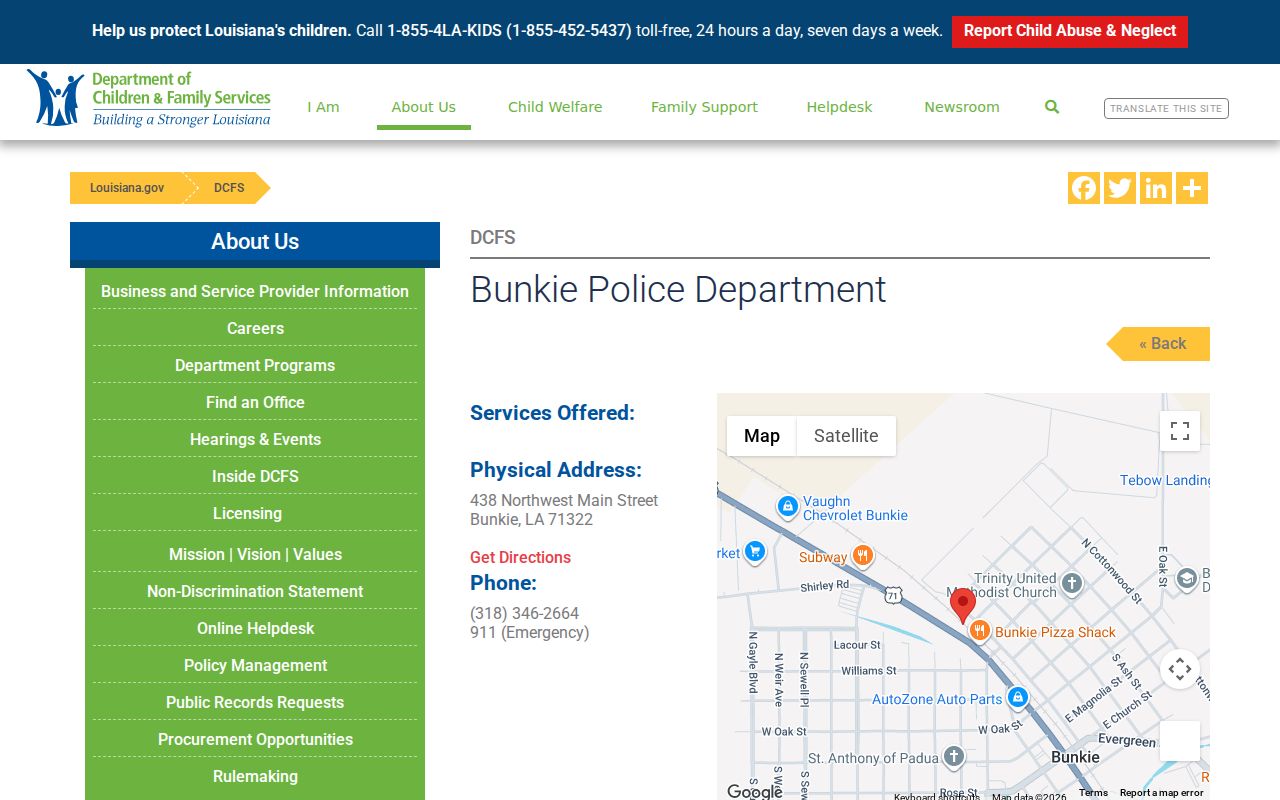
The directory confirms routing information but does not offer a report-copy form, fee schedule, case search, records email, or processing promise.
A Misdemeanor May Stay in Bunkie
A common mistake is to search only the Avoyelles Clerk. Bunkie has a genuine city-court layer with criminal significance, so a local or qualifying misdemeanor, traffic case, citation, or bench warrant can remain in City Court instead of appearing as a 12th JDC file. The court’s independent identity is part of Bunkie’s municipal structure, not merely a payment desk.
Current jurisdiction must be confirmed rather than inferred. Enrolled 2026 legislation describes territorial jurisdiction involving Wards 7, 8, 9, and 10 and concurrent misdemeanor and juvenile jurisdiction with the 12th JDC. Effective dates and codification matter, so the court should confirm which rules govern the specific filing date.
Arrests and Bookings in Bunkie
A Bunkie arrest begins with the arresting agency’s report. If the person enters parish detention, APSO then creates the booking record and LAVNS may expose custody information. Booking can show intake, charge descriptions, bond, housing, and release or transfer status, but it is not the officer narrative or the final court outcome.
A roster no-result is not conclusive. It can reflect timing, release, transfer, or a name variation. Call the arresting agency for the report and APSO corrections for booking clarification. The Avoyelles Parish arrest guide explains those parish channels in more detail while the city page keeps the local police and court distinction in view.
From Bunkie Police to LAVNS
The record timeline typically begins at 438 Northwest Main, continues to an APSO booking if parish detention occurs, and then branches to Bunkie City Court or the 12th JDC. Each system updates at a different point. A police report may exist before a roster result; a docket may appear after prosecutorial review; a final disposition comes later still.
For a completed history, match the report and booking to the court outcome. Arrest and charge labels can change through amendment, reduction, dismissal, plea, or adjudication. An arrest alone does not prove guilt, and an online custody screen does not establish the final case result.
Bunkie Municipal Court Records
Bunkie City Court is a one-judge city court supported by a marshal. Stable official sources did not publish a public criminal docket, copy procedure, clerk hours, fee schedule, or standard search fields. City Hall or the marshal can route a caller to the current clerk counter. Ask for the specific docket, minutes, disposition, or warrant entry, not merely “a background check.”
| Court Name | Bunkie City Court, with a city marshal |
|---|---|
| Case Types Heard | Local and qualifying misdemeanor, traffic, citation, warrant, and juvenile matters within current statutory jurisdiction |
| Case Lookup Channel | Telephone or clerk counter; no official online criminal docket located |
| What the Docket Shows | Citation or complaint, docket number, settings, minutes, plea, disposition, fine and cost ledger, and capias activity when maintained |
| Copies & Fees | Office-defined; ask about inspection, ordinary copies, certified dispositions, delivery, and charges |
Online Payment Is Not Case Lookup
The Bunkie city information site identifies municipal departments, meetings, and online payment access.

A payment tool can accept an amount without exposing the full docket. Paying a citation also does not automatically deliver certified minutes or a final disposition. Request those documents from City Court, particularly when correcting one’s record or proving how a case ended.
City Hall is at 105 Walnut Street, P.O. Box 630, Bunkie, LA 71322, telephone 318-346-7663. The Louisiana Municipal Association profile reports weekday hours of 8:00 a.m. to 5:00 p.m.; call to confirm the current clerk route before traveling.
Where Bunkie Records End Up
A local incident report does not automatically become a statewide public result. Fingerprints and later dispositions may feed the Louisiana Computerized Criminal History repository maintained by Louisiana State Police BCII. Louisiana does not offer unrestricted public LACCH name searching; Internet Background Check serves authorized account users.
Record flow: Bunkie Police › Bunkie City Court or Avoyelles Parish Courts › Louisiana State Police Bureau of Criminal Identification and Information
Use the creating office for recent local activity and certified court records for the outcome. For one’s own statewide cycle, Right to Review can reveal whether an arrest and disposition matched. Correcting a mismatch may require documents listing every original charge, amendment, final result, and sentence.
Verifying a Bunkie Capias
Do not rely on an old screen, payment page, or third-party result to decide whether a warrant is active. Provide the Bunkie Marshal and City Court with the full name, case or citation number, and approximate date. Ask the issuing court to confirm current status and what official action, if any, is required.
A district-court bench warrant follows a different route through the Avoyelles Clerk and 12th JDC. The Avoyelles criminal court case page explains district filings. If the warrant is encountered during direct law-enforcement contact, follow officer instructions rather than attempting to resolve the record informally.
Bunkie Data During NIBRS Transition
Bunkie had 3,346 residents in the 2020 Census, ranking second among Avoyelles Parish incorporated places. Citywide crime statistics should be taken from the FBI Crime Data Explorer by selecting Bunkie Police, recording the year, and noting agency coverage.
Louisiana’s 2024 Legislative Auditor report warns that the state’s NIBRS transition affects interpretation. Missing or partial reporting cannot be translated into “no crime,” and changes in coverage can mimic a trend. Aggregate counts provide community context but cannot confirm an individual police report, booking, warrant, or conviction.
When a Charge Becomes a Felony File
A felony or district prosecution moves beyond the city-court channel to the Avoyelles Clerk and 12th JDC. Search with a full name, date of birth if accepted, docket number, and approximate date range. Ask for the charging instrument, minutes, rulings, plea or verdict, sentencing entry, and certified disposition as needed.
That branch explains why two people arrested by the same police department can have records in different courts. Jurisdiction, prosecutorial decision, and charge level control the destination. The most reliable search follows the specific charge rather than assuming every Bunkie matter stays local or every matter goes to Marksville.
When the destination is uncertain, ask City Court whether it has a docket under the name and date, then ask the Avoyelles Clerk the same focused question. A filing may follow an arrest after some delay, and the prosecutor’s charging decision can differ from the initial police or booking label. Checking after the next setting can resolve a temporary gap.
Public Access Rules
Louisiana’s Public Records Law applies to records held by municipal custodians, but access remains subject to exemptions and court restrictions. Active investigative material, juvenile information, sealed or expunged records, protected identifiers, and other restricted content may be withheld or redacted. Ask the custodian to identify the legal basis for a denial and whether a separable public portion can be produced.
A strong request names the record, date range, subject, and preferred delivery method. It distinguishes inspection from an ordinary or certified copy. Send the police request to police and the docket request to court instead of asking City Hall for a combined history. If charges are not published, request an estimate before ordering and retain the response as a record of what was searched.
Key Statutes:
Louisiana Public Records Law, R.S. 44:1 - Establishes definitions and duties for access to public records.
Louisiana R.S. 44:3 - Provides law-enforcement and investigative-record limitations.
Louisiana R.S. 33:441 - Addresses mayor’s courts and municipal-ordinance jurisdiction, useful context when distinguishing Louisiana local court structures.